
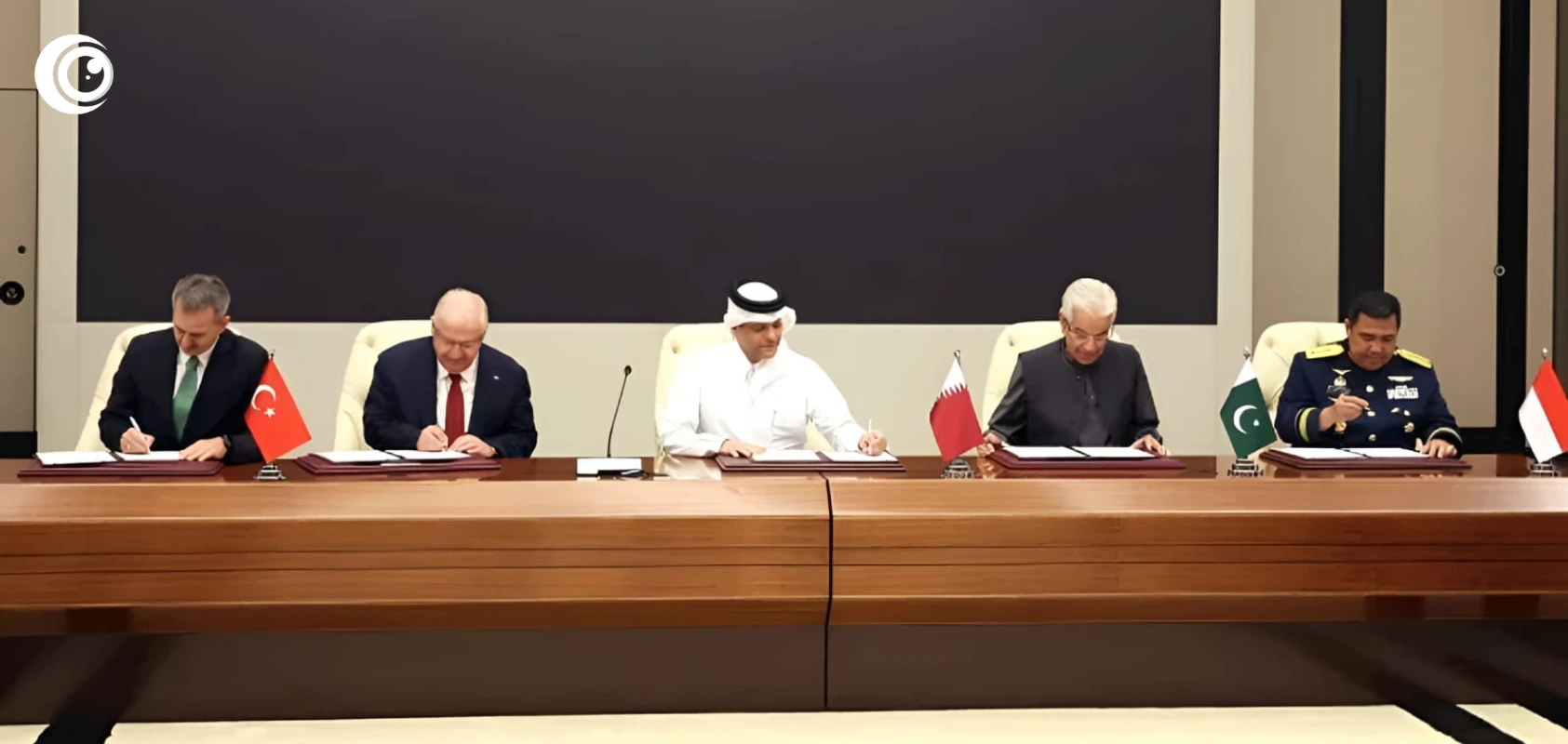

In a significant development for defence industrial cooperation, four Muslim-majority nations signed a joint military production framework in Doha, marking an attempt to shift from buyer-seller dependency toward collective manufacturing.
As confirmed by the Turkish Ministry of National Defence and Qatar’s Ministry of Defence, and reported by DAWN, Daily Sabah and Al Jazeera, Turkiye, Qatar, Pakistan and Indonesia signed the Badr Memorandum of Understanding on Wednesday, Oct 21, in Doha. The document lays the groundwork for joint production of military hardware, technology transfer, technical training, and joint research and development. Officials stressed it is an industrial cooperation framework, not a mutual defence pact.
The weight of the agreement lies in the complementary capabilities of its signatories. Turkiye brings a mature, combat-tested defence industry in drones and armored systems, Pakistan brings decades of experience in missile development and fighter co-production, Indonesia brings large-scale naval shipbuilding capacity, and Qatar brings financial capital and logistical infrastructure to sustain long-term programs.
According to the Qatari statement, the MoU was named Badr in reference to the full moon, symbolizing complementarity. For many observers, however, the name inevitably evokes doctrinal significance, as Badr in Islamic history represents collective defense against a larger coalition. Whether interpreted as astronomical or historical, the naming frames the pact as more than a commercial deal.
The critical test remains its direction. The official text describes cooperation to meet the needs of “allied and friendly nations” and to reduce reliance on external suppliers. It does not clarify how this industrial integration will interact with existing security architectures in the region, including long-standing partnerships with non-Muslim powers and the presence of foreign bases hosted by some signatories.
Its value will therefore not be determined by the signing ceremony. If the framework is used to build a genuinely independent industrial base that protects collective sovereignty and reduces dependence on Western supply chains, it represents a break from the old dependency model. If it merely reorganizes production while remaining embedded in external security architectures, the industrial gains will remain limited.