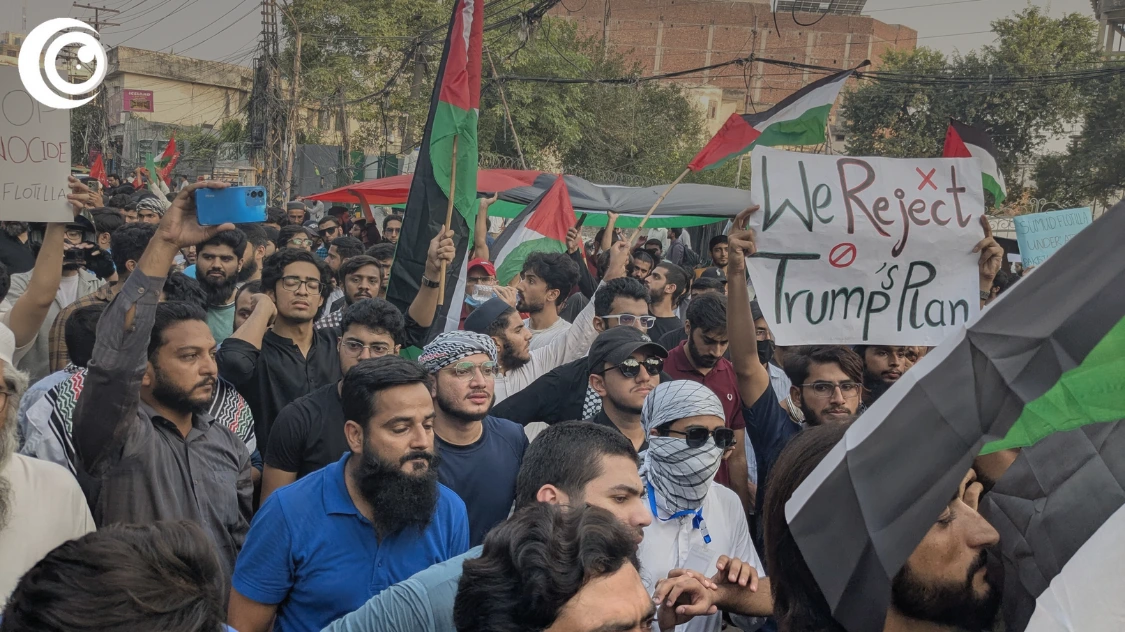
Islamabad, Pakistan – Mass demonstrations erupted across Pakistan on Thursday after Israeli naval forces attacked and intercepted the Global Sumud Flotilla in international waters, detaining lead of the Pakistani delegation former ex-Senator Mushtaq Ahmed Khan. The protests, called by the Palestine Action Coalition – a united coalition of pro-Palestinian activist organisations across Pakistan – were staged in five major cities, including Islamabad, Karachi, Lahore, Multan, and Faisalabad.
In his final recorded voice message before being detained, Mushtaq Ahmed Khan had warned that if Israel attempted to intercept the flotilla, Pakistanis have to rise in mass mobilization. His words became a reality as thousands poured onto the streets, waving Palestinian flags and demanding accountability from Israel and its backers. The Pakistani delegation, though one among many international teams aboard the flotilla, held symbolic importance as it represented the only Muslim-majority nuclear state sending parliamentarians and activists to join the mission.
The Global Sumud Flotilla, made up of civil society activists, doctors, parliamentarians, and humanitarians from over 40 countries, sought to deliver life-saving aid to Gaza in defiance of Israel’s blockade, which has been condemned for years as collective punishment. Israel, however, struck in international waters an act that international maritime law experts argue constitutes piracy and a war crime. The blockade itself, maintained since 2007, has already been deemed illegal under the Fourth Geneva Convention. Yet, Israel continues it unabated, shielded by Western allies who veto international accountability and supply the weapons that enforce it.
Strategically, Israel’s attack underscores its increasing reliance on brute force rather than diplomacy. By seizing unarmed humanitarians, it exposes the fragility of its moral claim to “self-defense.” International legal scholars have long argued that targeting civilians or humanitarian convoys is not security but a violation of the very principles the global order claims to uphold. The United States and United Kingdom, by providing military and diplomatic cover for these actions, implicate themselves directly in sustaining what rights experts widely call a system of apartheid and ethnic cleansing. Arab regimes, meanwhile Egypt, Saudi Arabia, the UAE, Bahrain stand condemned by their silence or quiet normalization with Tel Aviv. Their complicity, dressed as “pragmatism,” is increasingly viewed by Muslim populations as betrayal of Islamic solidarity and a denial of the Qur’anic injunction to stand with the oppressed.
The humanitarian impact cannot be overstated. Gaza’s population over two million people, half of them children faces starvation, lack of medicine, and destroyed infrastructure. The flotilla’s aid, though modest in quantity, carried symbolic weight, representing global civil society’s refusal to accept Israel’s starvation siege as normal. Blocking it is not merely a political act but, as critics note, a war against the most vulnerable: children, the sick, and the elderly. In Islamic ethics, the protection of innocents is a binding principle; in international law, starvation of civilians is a war crime. Israel’s decision to act against both reveals the extent of its disregard not only for legal norms but for basic human decency.
Reactions worldwide are already building. Human rights groups such as Amnesty International and Human Rights Watch have condemned Israel’s actions, while legal experts call for international tribunals to hold it accountable. In Pakistan, the Palestine Action Coalition declared that these demonstrations are only the beginning, vowing sustained mobilization until the detained activists are released. Protesters also pointed fingers at Washington and London for arming and shielding Israel, and at Arab rulers for choosing trade deals over justice.
As of now, the detained members of the flotilla remain in Israeli custody, their fate uncertain. What is certain is that Israel’s aggression has once again united ordinary people across the world against its siege, and in Pakistan, Mushtaq Ahmed Khan’s call has ignited a movement that may reshape the country’s pro-Palestinian activism. The struggle now extends beyond Gaza’s borders it is a test of whether humanity, law, and Islamic solidarity can overcome bombs, blockades, and betrayal.
.