
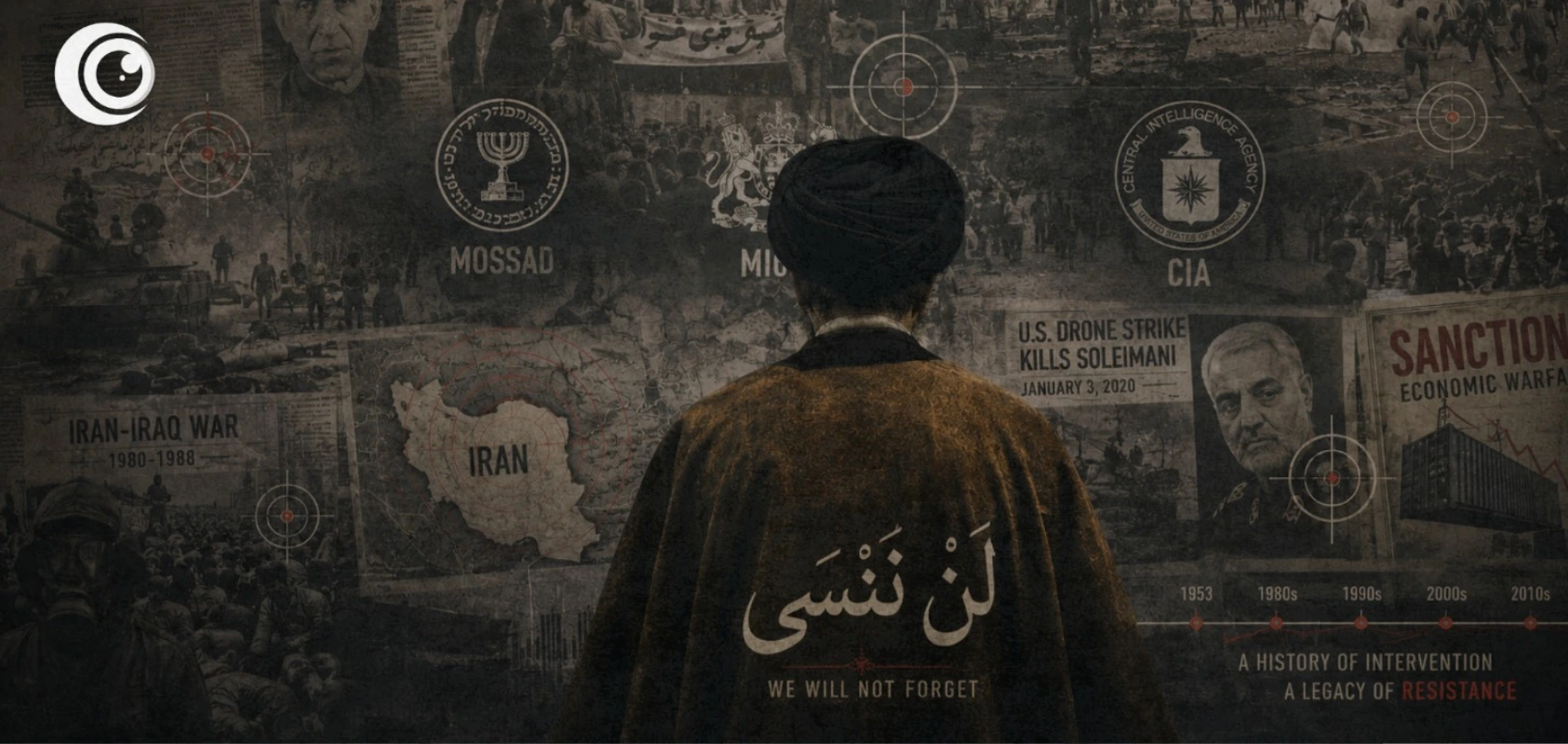
The vow of revenge made by Iran’s new supreme leader Imam Syed Mujtaba Khamenie following the killing of his father, Ayatollah Ali Khamenei, is not simply a reaction to one event. It is the latest chapter in a much longer story of confrontation, foreign intervention, and unresolved grievances that have shaped Iran’s relationship with Western powers for decades.
For Iran, history is not something buried in textbooks. It is a living memory of coups, wars, sanctions, assassinations, and foreign pressure. To understand Iran’s response today, one must understand the events that created this deep sense of mistrust.
A History Written With Foreign Intervention
Iran’s modern political history has repeatedly been shaped by outside powers.
In 1953, Iran’s democratically elected Prime Minister Mohammad Mosaddegh was removed in a coup supported by the CIA and Britain’s MI6 after his decision to nationalize Iran’s oil industry threatened Western economic interests. The overthrow of Mosaddegh became one of the defining examples of foreign intervention in modern Middle Eastern history.
For many Iranians, this event created a lasting belief that Western powers support democracy only when governments serve their interests. When national sovereignty challenges strategic or economic goals, principles are often replaced by power politics.
The Iran-Iraq War: A Memory of Abandonment
The Iran-Iraq War further strengthened this perception.
When Saddam Hussein’s Iraq invaded Iran in 1980, the conflict became one of the bloodiest wars of the 20th century. Iraq received political, intelligence, and military support from several foreign powers during the war, including Western states that viewed revolutionary Iran as a strategic threat.
The use of chemical weapons by Iraq against Iranian soldiers and civilians remains one of the darkest parts of the conflict. Despite international condemnation, the response from many powerful nations was shaped by geopolitical interests rather than a consistent application of international law.
For Iran, this became another example of what it sees as a repeated pattern: human rights are defended when convenient, but ignored when they conflict with strategic objectives.
The Modern Era of Pressure and Retaliation
The confrontation continued into the 21st century.
Years of sanctions placed enormous pressure on Iran’s economy, with Western governments claiming they were necessary to restrict Iran’s nuclear program and regional activities. However, these sanctions also affected ordinary Iranian citizens by limiting economic growth, trade, and access to resources.
The killing of General Qasem Soleimani in a US drone strike in 2020 became another turning point. The United States justified the strike by accusing Soleimani of planning attacks against American forces, while Iran viewed it as an unlawful assassination and a direct attack on its sovereignty.
For Iranian leadership and many of its supporters, Soleimani’s death was added to a long list of events that reinforced the belief that confrontation with the West was unavoidable.
Mojtaba Khamenei and the Politics of Revenge
Mojtaba Khamenei’s statement of revenge comes from within this historical framework.
For Iran’s leadership, revenge is presented not simply as retaliation but as a response to decades of perceived aggression. It reflects a political culture shaped by the belief that weakness invites further pressure and that deterrence requires a strong response.
However, this approach also raises a difficult question: does revenge bring justice, or does it continue a cycle where every attack creates the foundation for another?
The answer will shape not only Iran’s future but the wider region.
The Double Standards of Global Politics
The conflict between Iran and Western powers has also exposed what many countries across the world describe as a contradiction in international politics.
Western nations frequently present themselves as defenders of democracy, human rights, and international law. Yet history has repeatedly shown that these principles are often applied selectively.
Military interventions, support for certain allies despite accusations of violations, economic warfare through sanctions, and political interference in foreign nations have created accusations that international rules are not applied equally.
This perception has been strengthened by events across the wider region, where powerful states have often faced limited consequences for actions that would be condemned if carried out by their rivals.
For many nations, the issue is not simply about individual conflicts — it is about whether global justice is truly based on principles or shaped by power.
The Unfinished Conflict Between Memory and Power
Iran’s response today cannot be separated from its historical memory.
The Islamic Republic has built much of its identity around resistance against foreign influence, while Western governments view Iran through the lens of security threats and regional influence.
Both sides remain trapped in a cycle where past events continue to influence present decisions.
The tragedy is that ordinary people often bear the consequences of these struggles while governments continue their geopolitical battles.
Conclusion
Mojtaba Khamenei’s call for revenge represents more than anger over a single incident. It reflects decades of accumulated grievances that have shaped Iran’s worldview and its relationship with the West.
From the overthrow of Mosaddegh to the Iran-Iraq War, sanctions, and assassinations, Iran’s leaders continue to frame their actions as part of a larger struggle against foreign pressure.
The world has entered an era where historical wounds are no longer forgotten — they are shaping modern conflicts.
Until major powers confront the contradictions between their declared values and their actions, the cycle of resentment, retaliation, and revenge will continue.