



What is unfolding around Somaliland is not a regional technicality or a marginal African development. It is a calculated geopolitical maneuver that follows a familiar pattern: exploiting legal ambiguity, manipulating recognition, and advancing foreign military interests under the cover of silence from the Muslim world. This is not diplomacy. It is strategic encroachment, carried out quietly and normalized gradually until resistance becomes difficult and consequences are dismissed as inevitable.
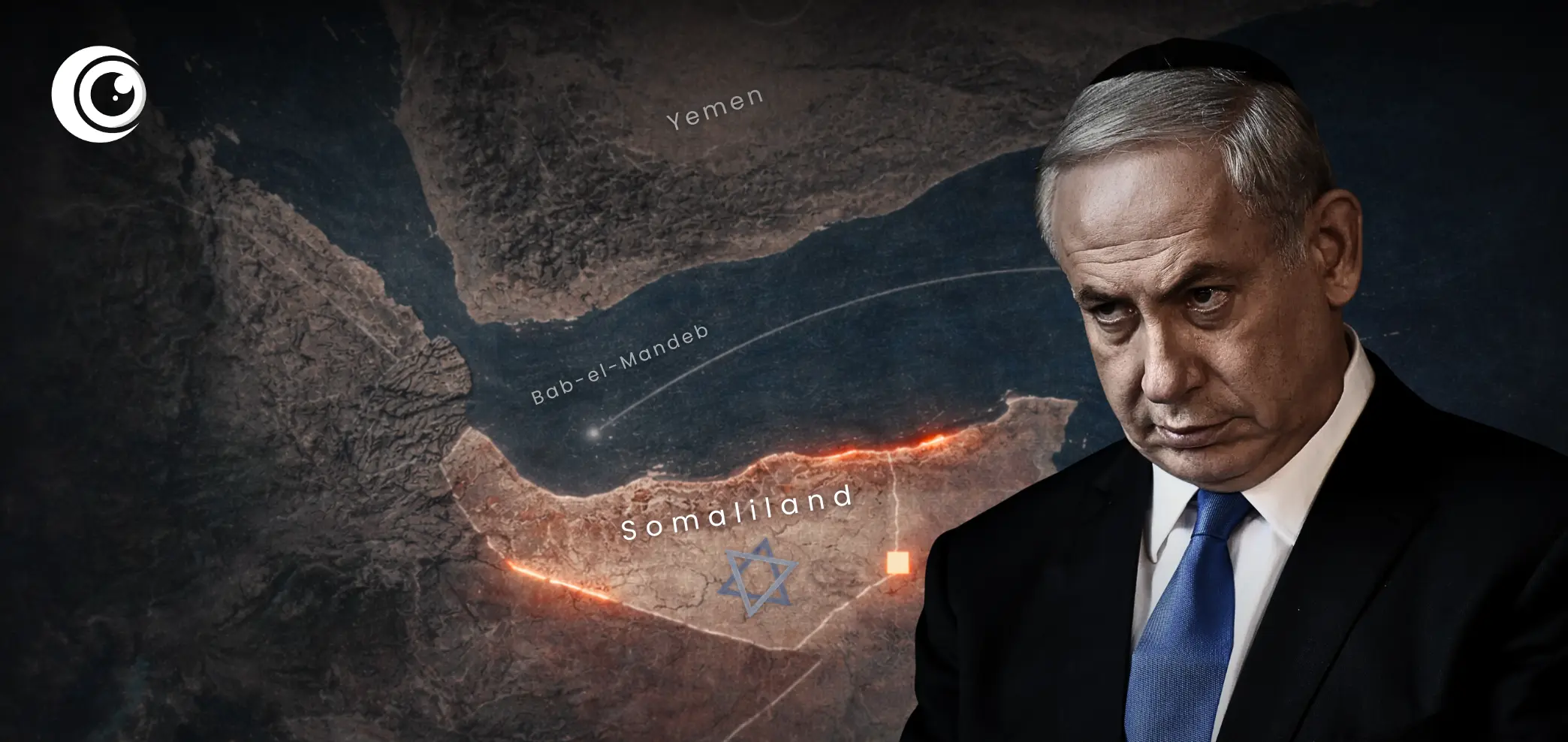
Somaliland declared separation from Somalia in 1991 after the collapse of the Somali state. Yet decades later, the reality remains unchanged. The United Nations does not recognize Somaliland as a sovereign state. The African Union does not recognize it. The overwhelming majority of the international community continues to treat it as an integral part of Somalia. Under international law, Somaliland remains Somali territory, without legal authority to host foreign military or intelligence infrastructure. This unresolved status is not an obstacle to external powers; it is an opportunity. Disputed territories have always been the preferred entry points for influence, allowing foreign actors to bypass accountability while reshaping realities on the ground.
Geography turns this maneuver from symbolic to dangerous. Somaliland sits directly across from Yemen, overlooking the Bab al-Mandeb Strait, one of the most critical maritime chokepoints in the world. This narrow corridor carries global oil shipments, international trade, and military transit linking Asia, Africa, and Europe. It is the same corridor where Yemen emerged as the most active front of pressure against Israel following the war on Gaza. Geography made Yemen unavoidable. Resolve made it effective.
While Muslim governments limited their response to statements, summits, and controlled outrage, Yemen acted. Despite years of war, blockade, and humanitarian catastrophe, Yemen targeted Israeli-linked shipping, disrupted trade routes connected to Israeli interests, and applied tangible pressure in defense of Gaza. Yemen did not rely on symbolism. It imposed consequences. For this reason, Yemen became a strategic concern for Israel, not because of rhetoric, but because it transformed solidarity into action.
Israel’s move toward recognizing Somaliland while the rest of the world continues to recognize Somalia is not a gesture of goodwill. Recognition here functions as a military and intelligence tool. It enables proximity to the Red Sea, access near Yemen, forward positioning against resistance forces, and influence over one of the world’s most vital maritime corridors. This explains the direct and unprecedented warning issued by the leader of Yemen’s Ansarallah movement.
Abdul-Malik al-Houthi stated that any Israeli presence in the Somaliland region would be considered a military target by the Yemeni Armed Forces, framing such presence as aggression against Somalia and Yemen and a threat to regional security that requires decisive action. This was not symbolic language. It defined Israeli presence as a violation of Somali sovereignty, a direct threat to Yemen’s security, and a destabilizing force in the Red Sea. Where others normalize, Yemen criminalizes. Where others remain silent, Yemen draws red lines.
The immediate victim of this maneuver is Somalia itself. Its territorial integrity is being challenged without consent. Its land is being reframed as negotiable strategic space. Its sovereignty is diluted through selective recognition and external pressure. Yet the response from Muslim institutions remains muted. The Arab League has offered no decisive stance. The OIC has provided no meaningful intervention. Major Muslim capitals have avoided confrontation. This silence follows a pattern already witnessed in Palestine, where sovereignty eroded not only through force, but through regional abandonment.
What is happening in Somaliland does not end in the Horn of Africa. It establishes a model. If a foreign power can unilaterally recognize disputed territory, normalize strategic presence under the language of security cooperation, and militarize legally unresolved regions without consequence, then this approach becomes replicable. Regions with contested political status, strategic coastlines, and manufactured security narratives, including South Asia and Pakistan, are not immune. Somaliland is not an exception. It is a test case.
This is not merely a Yemen-Israel issue, nor a Somali internal matter. It is a confrontation between sovereignty and manipulation, resistance and containment, dignity and submission. Yemen’s warning is not only directed at Israel. It is directed at a Muslim world that continues to allow its lands to be treated as negotiable chessboards. If disputed territories can be quietly recognized, militarized, and normalized without resistance, then the next bases will not be far from our borders, and once again, the decisions will be made without us.
Silence did not protect Palestine. It will not protect Somalia. And it will not protect what comes next.