

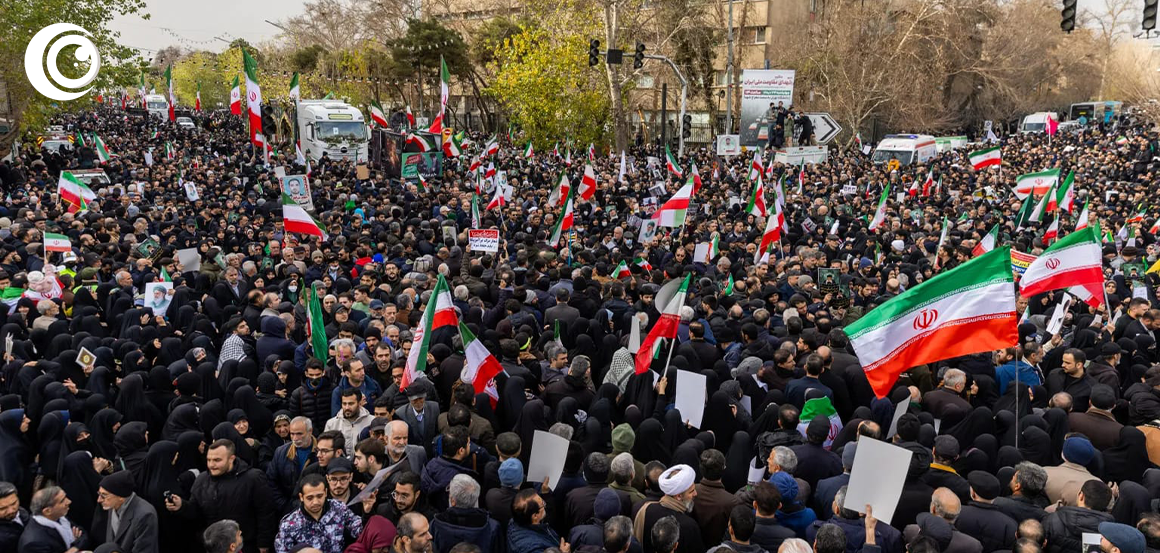
In a display of pointed religious and political symbolism, thousands of Iranians marked the 47th anniversary of the Islamic Revolution yesterday by burning an effigy of the ancient Canaanite deity Baal alongside the flags of Israel and the United States.
The demonstration, held at the foot of the Azadi Tower, signaled a shift in the regime’s rhetoric. While flag-burning is a staple of revolutionary commemorations, the introduction of Baal a figure associated in Abrahamic tradition with paganism and child sacrifice directly mirrors a wave of allegations currently saturating global social media following the massive release of the “Epstein Files” by the U.S. Department of Justice.
The decision to burn a statue of Baal is not merely a callback to ancient scripture. Protesters in Tehran explicitly linked the effigy to recent headlines regarding the late financier Jeffrey Epstein.
Since the release of over 3 million pages of documents under the 2025 Transparency Act, online discourse has been dominated by claims that Western power brokers engaged in ritualistic abuse. The “Baal” connection specifically stems from:
Viral social media posts have alleged that Epstein maintained a bank account or wire transfer destination labeled “Baal.” While some analysts suggest this may be a clerical error or a reference to a different entity, the name has become a rallying cry for those convinced of a deeper, occult layer to the scandal.
Protesters held placards referencing the testimony of former Dutch banker Ronald Bernard, whose 2017 claims of “Luciferian” child sacrifices among financial elites have resurfaced alongside the new file dumps.
For the demonstrators, the documented presence of high-profile Western politicians, billionaires, and royals at Epstein’s properties serves as proof of a “moral rot” that they equate with the ancient cults of Baal.
“We are not just burning a piece of wood,” said one demonstrator in Enghelab Square. “We are burning the symbol of the modern child-eaters who run the West. The Epstein files have shown the world what we have known for decades: their leadership is demonic.”
The 47th anniversary comes at a time of extreme friction. With Israel and Iran having engaged in direct conflict over the past year, the Iranian government is increasingly using “satanic” imagery to frame its adversaries.
By inscribing the Star of David on the chest of the Baal statue, the organizers sought to blend geopolitical opposition to Israel with the sensationalist “blood libel” theories surrounding the Epstein case. While Western critics argue that these connections are a leap into unfounded conspiracy, for the crowds in Tehran, the “leaked files” represent a definitive unveiling of their enemies’ true nature.
The Epstein document release has created an unusual alignment between disparate groups worldwide. From populist movements in the West to theocratic revolutionaries in the Middle East, the narrative of a “predatory elite” has become a unifying theme.
Iranian state media outlets have spent the last 48 hours broadcasting segments on the “Occultism of the White House,” utilizing the Epstein files to argue that the “Great Satan” is not a metaphor, but a literal description of Western governance.