More than 7,000 activists including a Soumoud convoy from Tunisia marching towards Gaza to break the Israeli siege of the strip.
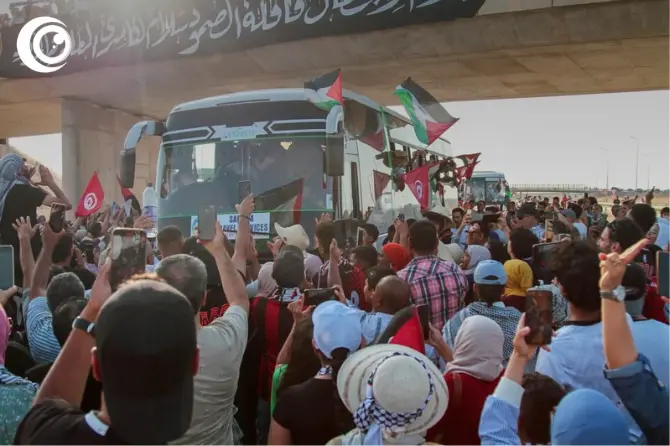
Thousands of activists have commenced the “Soumoud” (steadfastness) convoy, a civilian-led humanitarian effort, as part of the “Global March to Gaza.” This large-scale mobilization, which began on June 9 and comprises over 7,000 activists and 300 vehicles from across North Africa, aims to reach the Rafah border with Gaza. Its objectives are clear: to deliver desperately needed aid, demand the establishment of a permanent humanitarian corridor, and intensify global pressure for an end to Israel’s prolonged blockade of the Gaza Strip. This convoy follows the violent interception in May 2025 of the “Madleen” Gaza Freedom Flotilla, an incident in which Israeli forces intercepted the humanitarian ship in international waters, injured several participants, and detained dozens of activists without charge, sparking widespread condemnation and revitalizing the global solidarity movement for Palestine.
Since 2007, Gaza has been subjected to an intense and widely criticized blockade imposed by Israel, which maintains control over all borders, airspace, and maritime access. Despite Israel’s assertion that the blockade is a security measure against Hamas, numerous international human rights organizations and UN bodies have unequivocally categorized this siege as collective punishment, a practice deemed illegal under international law. This sustained blockade has resulted in severe and ongoing shortages of essential supplies, including medical equipment, food, electricity, and clean water, for Gaza’s over 2 million residents, a majority of whom are children.
The current “Soumoud” convoy, involving civil society members such as doctors, lawyers, students, and journalists, departed simultaneously from Tunisia, Mauritania, Morocco, Algeria, and Libya, intending to arrive in Cairo by June 12 before proceeding with a three-day march toward the Rafah crossing. This initiative plans to grow in participation and momentum as it traverses various cities, aiming to amplify regional and international attention on the humanitarian crisis.
The strategic implications of this movement are significant, particularly for Egypt, which controls Gaza’s only non-Israeli crossing point at Rafah. While Egypt has, at times, opened the crossing, its operations often appear to be influenced by Israeli and Western pressure, resulting in persistent restrictions. A mass civilian-led march of this magnitude is expected to exert visible pressure on regional governments to prioritize humanitarian action over existing political alliances.
Globally, this increasing mobilization of civil society underscores a growing frustration with international inaction. While Israel continues to receive substantial military and diplomatic support from powerful Western nations, the “Global March to Gaza” serves as a direct challenge to the perceived silence of global institutions in the face of prolonged suffering and potential violations of international law.
The humanitarian situation in Gaza has been described by UN officials as that of “an open-air prison,” with nearly 80% of its population relying on international aid for survival. The blockade severely restricts the entry of vital goods, including critical medical equipment and building materials, profoundly impacting hospitals, schools, and homes, particularly in the aftermath of recurrent Israeli airstrikes. Independent investigations have documented widespread damage to purely civilian zones, despite claims by Israel of targeting military assets.
Furthermore, recent reports from prominent international human rights watchdogs, including Human Rights Watch and Amnesty International, have issued stark warnings about conditions in Gaza and the occupied West Bank that they assert resemble apartheid and even ethnic cleansing. The indiscriminate nature of Israeli airstrikes, which have affected refugee camps, hospitals, and UN-run schools, has led many legal scholars to argue that war crimes may have been committed.
Reactions from global and regional actors have been varied. The African Union and several North African governments have expressed support for the right of humanitarian convoys to reach Gaza. However, direct condemnation of Israel’s actions from many governments remains limited, reflecting complex geopolitical considerations and concerns about potential retaliation or diplomatic fallout.
In contrast, UN Special Rapporteurs have repeatedly urged Israel to lift the blockade, unequivocally citing it as a clear violation of the Geneva Conventions. Public outrage continues to mount globally, evidenced by large-scale protests erupting in major cities from Istanbul to Johannesburg to Kuala Lumpur. Yet, leading Western governments have largely maintained a stance of silence or offered vague calls for “restraint on both sides,” even as evidence increasingly points to disproportionate use of force by Israel and systemic discrimination against Palestinians.
As the “Soumoud” convoy continues its journey through North Africa, it is steadily building momentum and drawing increased global attention. Thousands more are expected to join the convoy from all over the world, including from 56 additional countries. The marchers intend to arrive at the Rafah border by mid-June, where they will issue a unified call for the establishment of a permanent, independent humanitarian corridor into Gaza.
While the convoy is committed to remaining peaceful, the risk of confrontation remains high, particularly if Egyptian or Israeli forces attempt to impede the initiative. Nevertheless, this movement has already achieved significant success in refocusing international scrutiny on the Gaza blockade and Israel’s contentious role in perpetuating one of the world’s most enduring humanitarian crises. The question of whether meaningful global action will finally materialize remains uncertain, but the participants of the march are resolute in their refusal to remain silent.