
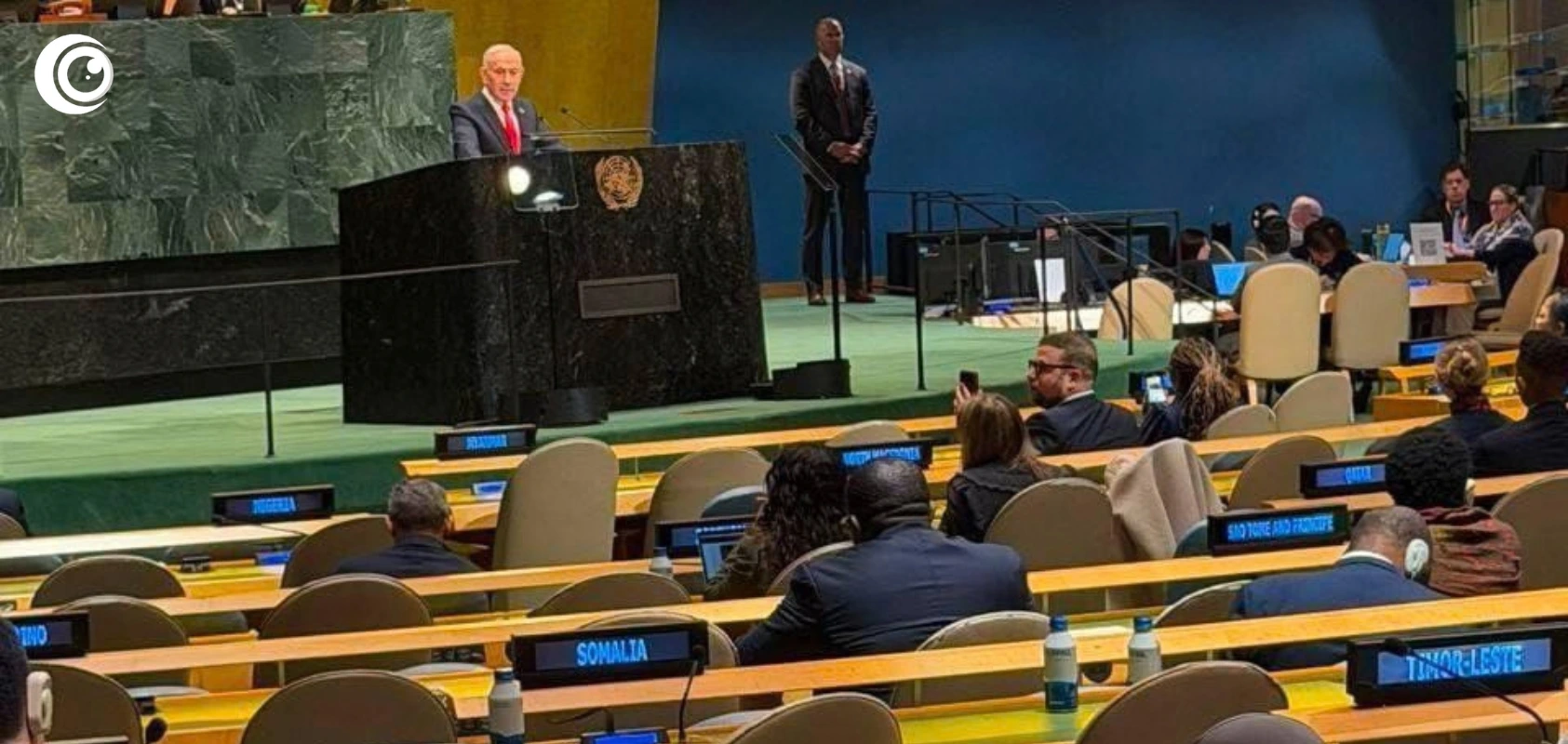



Israeli occupation Prime Minister Benjamin Netanyahu began his address at the United Nations General Assembly on Friday to a largely empty hall after scores of delegations staged a coordinated walkout in protest. The walkout began immediately after Netanyahu was announced and approached the podium, with diplomats from numerous countries standing up from their seats and moving toward the exits in a visible display of dissent.
Live footage from inside the General Assembly hall captured the scale of the protest, showing entire rows of seats becoming vacant within minutes. As Netanyahu started his speech, some delegates could be heard booing and heckling before leaving the chamber, while most exited silently. The departure of almost all delegations left large portions of the hall empty, marking one of the largest walkouts of this year’s session.
Despite the mass walkout, a small number of delegations chose not to leave and remained in their seats for the duration of the speech. Among those who stayed was the representative of the United Arab Emirates, who was seen seated and listening as the hall emptied around him. A few other delegations also remained in the chamber and did not participate in the boycott.
Netanyahu continued with his address despite the reduced attendance, outlining the Israeli occupation’s position on the ongoing war in Gaza, regional security, and its relations with neighboring states. His speech at the UNGA comes amid intensifying international criticism of the Israeli occupation’s military campaign in Gaza and ongoing legal proceedings at the International Court of Justice and the International Criminal Court.
The walkout reflects growing divisions within the United Nations over the conflict, with many member states expressing frustration over the continued genocide and the humanitarian crisis in Gaza. In recent months, an increasing number of countries have called for an immediate ceasefire, expanded aid delivery, and a renewed push for a solution.
The protest at the General Assembly is seen as a symbolic gesture of disapproval rather than a formal procedural action, but diplomats involved said it was intended to signal that many nations are no longer willing to listen to justifications for the war while civilian casualties continue to rise in Gaza.