
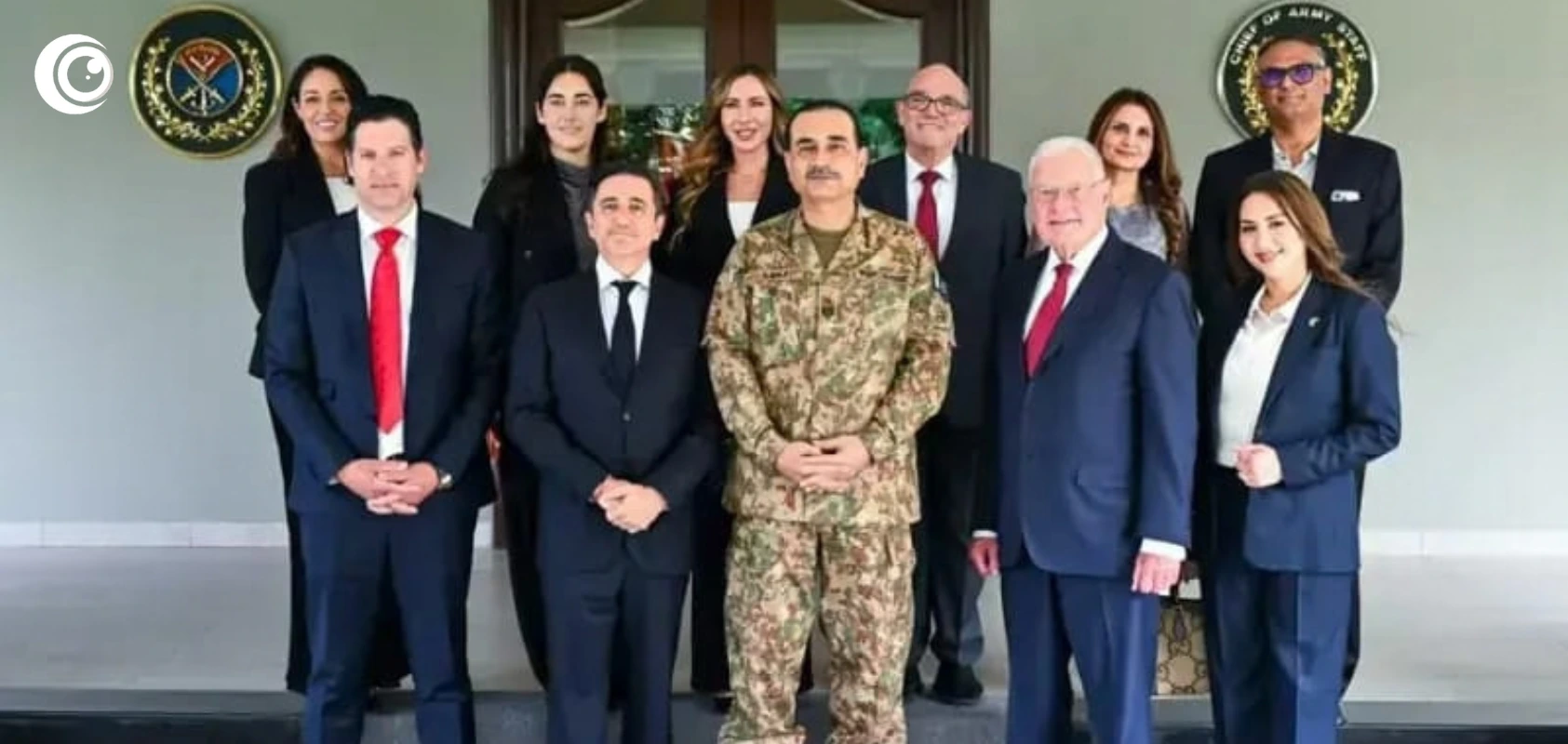


Pakistan’s military leadership has quietly finalized defense procurement agreements with Powerus, a US-based autonomous drone company co-founded by a former officer of the Israeli intelligence, according to documents and revelations published by a youth led activist group, Quds Youth Movement. The Quds Youth Movement, in what it described as a cyber resistance operation, exposed that Pakistan’s Field Marshal Asim Munir personally hosted Powerus executives at General Headquarters in Rawalpindi to finalize procurement orders and a memorandum of understanding for autonomous drones and counter-UAV technology. The deal was sealed on September 16, 2026.
Pakistan does not formally recognize the Israeli occupation, and its passport explicitly bars travel to the entity. Millions across the nation have taken to the streets to condemn the genocide in Gaza and express solidarity with the Palestinian resistance. The military’s public posture has long mirrored this stance, with leadership repeatedly affirming commitment to the Palestinian cause. Yet behind closed doors, the puppet military leadership signed defense procurement agreements with a firm whose co-founder and Chief Technology Officer is a former officer of the Israeli occupation forces.
Powerus is the trading name of Autonomous Power Corporation. Its co-founder and CTO, Ziv Marom, served as an officer in the Israeli occupation forces before moving into the defense technology sector. His presence at the top of a company now supplying Pakistan’s armed forces has ignited outrage across the country, with critics asking how the military leadership can preach solidarity with Gaza while bankrolling contractors run by former Israeli military personnel.
The Powerus delegation was led by co-founder Brett Velicovich, a former US Army Special Forces intelligence officer. According to Inter-Services Public Relations, discussions at GHQ covered “defence procurement, production and long-term capacity building”. Powerus later confirmed a limited procurement order from Pakistan’s Ministry of Defence for unmanned aerial systems, along with a strategic MoU for broader autonomous systems cooperation. The order’s value and specific systems remain undisclosed, citing security sensitivities.
The financial architecture behind the firm further underscores the troubling nature of the deal. Powerus is preparing to go public through a merger with Aureus Greenway Holdings, a Nasdaq-listed golf-course operator based in Florida. The merger was brokered by Dominari Securities, a boutique investment bank in which Donald Trump Jr. and Eric Trump hold indirect stakes through American Ventures LLC, expected to hold approximately 9.9 percent of the combined company.
What the military’s statement omitted is equally critical. Powerus has simultaneously licensed its Guardian-1 counter-drone technology to India’s Paras Defence and Space Technologies, granting exclusive rights to manufacture and commercialize the system in India. The agreement was signed in June 2026, months before the Pakistan deal, proving that Powerus profits from both sides of the Pakistan-India rivalry while GHQ willingly hands over public money.
The MoU’s framework for joint ventures to move drone manufacturing into Pakistan signals a long-term strategic alignment. Powerus CEO Andrew Fox stated, “Pakistan has the opportunity not only diplomatically but economically, to create industry here, create jobs, and create export opportunities. This is more than a one-off for us. This is the establishment of a long-term relationship.” The relationship comes at a time when the Trump administration has publicly praised Field Marshal Munir as a “favourite field marshal”, following months of shuttle diplomacy on a US-Iran ceasefire. The confluence of political warmth and defense procurement raises fears that Pakistan is being drawn into a broader regional architecture that serves Israeli and American interests at the expense of the Ummah.
The humanitarian and legal concerns are profound. While the military leadership publicly claims solidarity with Gaza, it is simultaneously bankrolling contractors run by former Israeli military personnel. The Guardian-1 interceptor is described as a high-speed, battery-powered counter-drone system designed to counter low-cost aerial threats. The same technology licensed to India’s Paras Defence will now be manufactured in India, potentially used against Pakistani forces in future conflicts. The MoU’s non-binding nature and the undisclosed value of the initial order have raised questions about transparency and accountability. Opposition politicians have already begun questioning the legal authority and true public cost associated with the deal. The Pakistani public, which has consistently opposed any normalization with the Israeli occupation, was kept entirely in the dark.
Reactions have been swift and furious. The Quds Youth Movement, which exposed the deal, has called for nationwide outrage. Social media users expressed disgust, with one writing, “Absolute disgrace, not surprised though. Pakistan has signed a deal with Powerus, an autonomous drone company that is being run by the former IDF officer Ziv Marom.” Powerus co-founder Brett Velicovich has defended the deal, telling Reuters the goal was “a joint technology relationship, pairing best-in-breed technology from the US with best-in-breed technology from Pakistan”. CEO Andrew Fox said contracts were awarded on merit and denied that political connections drove the deal. Pakistan’s Defense Minister Khawaja Asif has previously stated that Pakistan has “neither taken any initiative nor received any proposal to join the Abraham Accords,” adding that normalization with the Israeli entity remains “unacceptable”. The military’s media wing, Inter-Services Public Relations, did not respond to requests for comment on the Israeli link.
The Powerus deal represents a watershed moment in Pakistan’s defense procurement history. It exposes a yawning gap between the military’s public rhetoric on Palestine and its private dealings with a firm co-founded by a former officer of the Israeli occupation forces. This new revelation has forced this contradiction into the open, but the military leadership has yet to offer any explanation. What remains to be seen is whether this exposure will translate into accountability or merely fade into the background of Pakistan’s fraught civil-military landscape. The MoU’s framework for expanded cooperation, subject to definitive agreements and US export controls, suggests this is only the beginning of a deeper relationship.
For millions of Pakistanis who have marched for Gaza, the question is simple: how can the military leadership pretend to serve the Ummah while bowing to the worst enemies of Islam and betraying every founding principle of the state?