
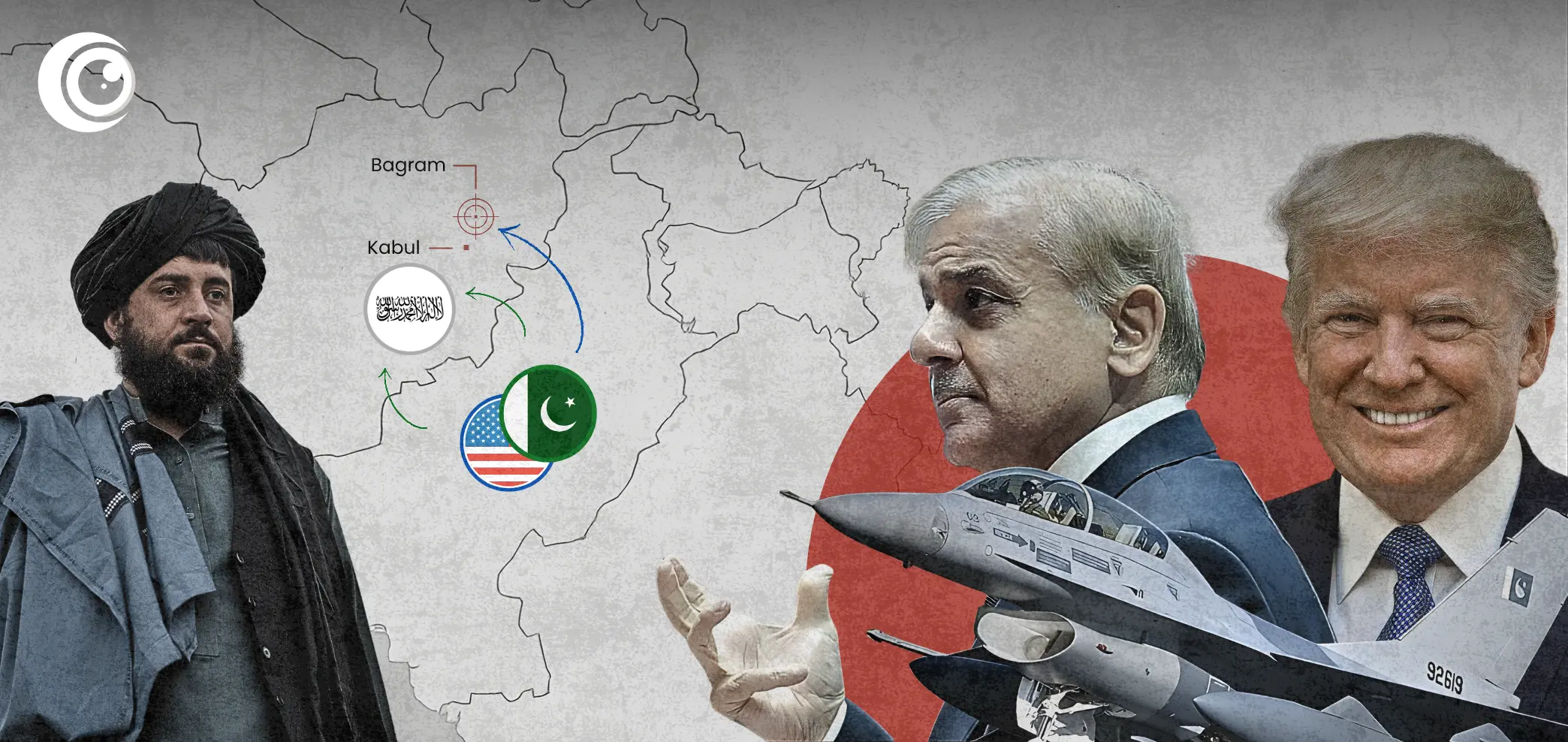
When Pakistan launched airstrikes inside Afghanistan last month, Pakistan justified it as a counterterrorism operation. Afghanistan, however, called it a blatant violation of sovereignty. But to treat this episode as a simple border clash is to ignore the larger design shaping South and Central Asia, one driven by Washington’s ambitions, Tel Aviv’s regional influence, and the complicity of regimes that long abandoned moral independence.
The sequence of events tells a story the headlines omit.
Weeks before the strikes, the United States issued public threats demanding renewed access to Afghanistan’s Bagram Airbase, a remnant of its twenty-year occupation. President Donald Trump, now again a political heavyweight, warned Kabul of “bad things” if the request was denied. The Afghan government refused.
Barely days later, Pakistan conducted cross-border operations targeting areas near Kabul and Paktika, killing civilians according to Afghan officials. The strikes arrived not as a coincidence but as a reaction perfectly aligned with Washington’s pressure campaign. The question naturally arises: did Pakistan act entirely on its own, or was it nudged-willingly or otherwise – into becoming a proxy instrument in a broader geopolitical script?
The Proxy Pattern Repeats
The region has seen this movie before. From Iraq to Syria, Libya to Yemen, every “counterterrorism” intervention dressed in the language of security has masked an ulterior goal of maintaining American presence and reshaping political realities to suit Western and Israeli interests.
By destabilizing Afghanistan and reigniting tensions with Pakistan, the U.S. gains several advantages without direct re-entry: a pretext for future involvement, justification for intelligence cooperation, and a weakened bloc of two Muslim nations that could have otherwise coordinated for regional stability.
Every drone strike, every escalation, every diplomatic fallout fuels the same outcome: dependency. Pakistan and Afghanistan, two nations with intertwined destinies, are once again pushed into playing opposite roles in someone else’s strategic theater.
America’s New “Peace” Strategy
This manipulation doesn’t exist in isolation. It connects directly to the broader normalization architecture unfolding across the Middle East from the Abraham Accords to the new “Abraham Shield” framework.
The same capitals pushing Pakistan and Afghanistan toward managed hostility are also encouraging Arab regimes to embrace Israel under the guise of “regional peace.” In truth, these agreements are designed to normalize occupation, cement U.S. military dominance, and silence dissent across the Muslim world.
Saudi Arabia, the UAE, Morocco, and even fractured Syria have taken visible or quiet steps toward normalization. Israel’s intelligence and cyber industries now penetrate Gulf economies, while Western defense companies profit from “joint security” initiatives that ultimately protect Israeli interests. The message is clear: align with Tel Aviv, or risk economic isolation.
Meanwhile, Gaza’s ruins remain unreconstructed, Palestinian political voices are fragmented, and resistance movements are systematically delegitimized as “terrorism.”
The same countries that once chanted solidarity are now signing investment memorandums with the very state enforcing a starvation blockade.
Manufactured Chaos as Leverage
For Washington, instability is a resource. A fractured Muslim bloc is easier to manage; a divided South Asia keeps China and Iran’s influence checked. When Pakistan bleeds economically and Afghanistan drowns under sanctions, new “partnership offers” and IMF-linked conditionalities appear, wrapped in diplomatic smiles.
Each conflict zone becomes a chessboard. One day it’s Syria, the next Gaza, now the Durand Line. The pattern is unmistakable: provoke local insecurities, frame intervention as “stabilization,” then use dependency to dictate the region’s political alignment.
Israel, for its part, benefits quietly. The more the Muslim world remains consumed by internal crises, the freer Tel Aviv is to expand settlements, bomb Gaza, and normalize ties under the radar. Every drone strike in Paktika, every economic collapse in Kabul, draws attention away from the core – the ongoing colonization of Palestine.
The Complicity Within
Perhaps more damaging than foreign interference is the submission of regional powers. Arab governments now openly trade intelligence with Israel; some have even allowed airspace to be used in attacks on Iran. Others remain silent as American bases expand across their soil. These are not acts of sovereignty, they are acts of surrender dressed as diplomacy.
The tragedy of the modern Muslim world is not that it is oppressed by outsiders; it is that much of its leadership has chosen comfort over conscience. The same rulers who speak of solidarity from podiums sign arms deals with those financing the destruction of Yemen, Syria, and Gaza.
Their silence during Palestine’s starvation siege, their absence when Lebanon or Iran faces Israeli strikes, and their cooperation when Pakistan or Afghanistan are destabilized – all reveal the deeper rot of moral decay behind polished press statements.
Pakistan and Afghanistan: Both Pawns, Not Players
Neither Pakistan nor Afghanistan emerges stronger from this exchange of fire. Pakistan loses credibility and risks economic retaliation; Afghanistan faces fresh displacement and diplomatic isolation. Both nations bleed while the USA regains leverage and regional dictators maintain their status quo.
This is why understanding who profits is vital. The United States rebuilds justification for renewed security ties. Israel gains breathing space to expand its normalization project. Gulf allies strengthen their dependence on Western defense guarantees. And two Muslim nations, bound by history and faith, drift further apart.
The Way Forward
Real sovereignty begins with refusing to be used. Pakistan and Afghanistan must rebuild dialogue independent of Western mediation, and their people must reject narratives that pit them against each other.
Until regional actors learn to identify external fingerprints on their crises, they will continue to serve as tools in someone else’s war. What is presented as “counterterrorism” today will tomorrow be repackaged as “peacekeeping” both carrying the same consequence: submission to foreign design.
The so-called global champions of democracy and human rights from Washington to London to Tel Aviv have long practiced a politics of controlled chaos. The tragedy is not that they continue to manipulate. The tragedy is that Muslim governments continue to let them.