
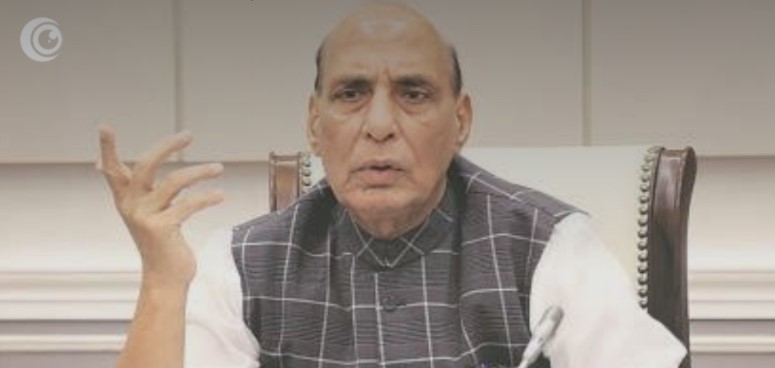

India’s Defence Minister Rajnath Singh has sparked outrage after suggesting that Sindh, an integral part of Pakistan, could “return to India,” reviving the colonial-era dreams and expansionist fantasies of the ruling BJP. His remarks, delivered at a Sindhi community event and framed through selective references to L.K. Advani’s writings, reflect an increasingly aggressive Hindutva narrative that normalizes territorial claims on neighbouring Muslim countries.
By glorifying pre-Partition nostalgia and invoking “civilisational ties,” Singh attempted to repackage a political agenda of annexation under the guise of cultural sentiment. Such rhetoric comes from a government that has already stripped Kashmir of autonomy, enforced demographic engineering, and systematically targeted Muslim-majority regions under its control. Now, these statements extend beyond India’s borders, openly hinting at redrawing internationally recognized frontiers.
Analysts view this as part of a broader ideological project where the BJP leadership routinely mixes mythological claims with contemporary geopolitics to justify expansionism. Singh’s claim that “borders can change” echoes the language of states that seek to revise geography through force, a precedent dangerous to regional stability.
Pakistan’s Sindh is not just a province; it is home to millions with a distinct culture, identity, and history. For a senior Indian minister to casually suggest its future absorption into India reveals the depth of nationalist extremism shaping New Delhi’s policies. At a time when India continues suppressing Kashmiris, marginalizing Muslims, and fueling violence through majoritarian politics, such statements serve as a reminder that the threat is not merely domestic, it extends to the region, backed by a mindset that sees neighbouring Muslim lands as territory to be reclaimed.