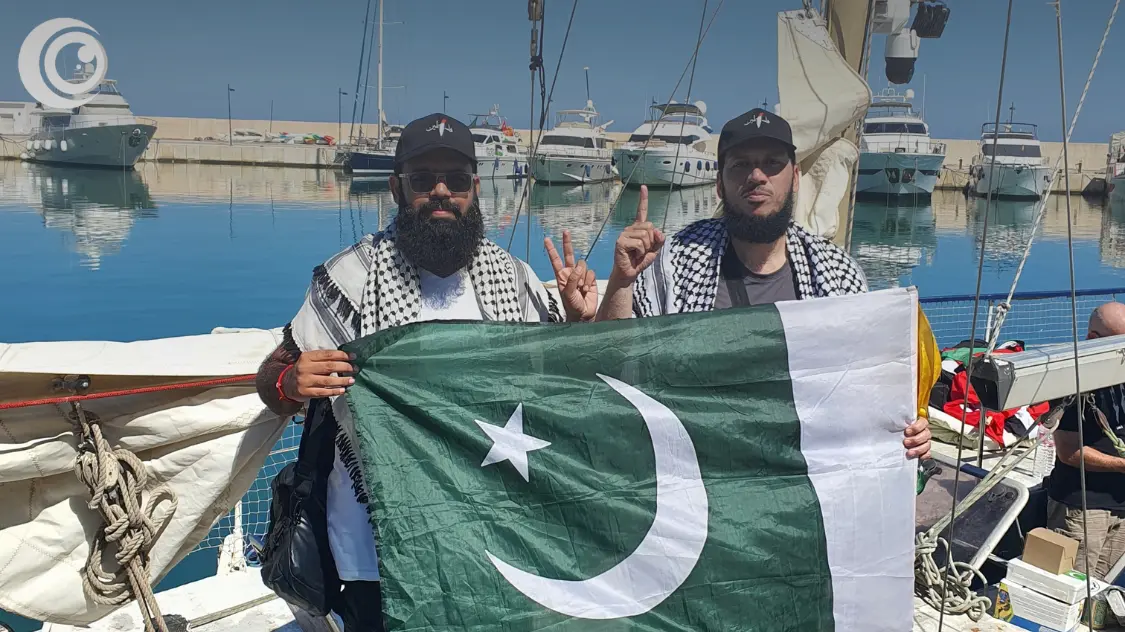
A Pakistani delegation, including former Senator Mushtaq Ahmed Khan and Dr. Osama Riaz, has departed from Gammarth Port in Tunisia aboard the Global Sumud Flotilla, seeking to sail to Gaza. Their aim is to break Israel’s naval blockade, deliver humanitarian supplies, and draw international attention to the escalating crisis that has left Gaza devastated under siege.
The blockade, enforced by Israel since 2007 and intensified after October 2023, has been widely condemned as a form of collective punishment. Over two million Palestinians remain trapped with shortages of food, medicine, clean water, and electricity. International law, including the Geneva Conventions, clearly prohibits starvation and obstruction of humanitarian aid, yet these remain daily realities. The flotilla, joined by activists from 44 countries, challenges this siege directly, continuing the legacy of earlier missions that were often met with violent Israeli responses.
Organizers report that the flotilla has already faced suspected drone strikes while docked in Tunisian waters, damaging at least one British-flagged vessel. While Israel has not claimed responsibility, and Tunisian authorities dispute the incidents, the attacks reflect the risks faced by international solidarity efforts. Despite this, the Pakistani delegation has completed formalities and remains committed to reaching Gaza, carrying supplies such as dates, clothes, and sleeping bags, and vowing to stay in the besieged enclave to break the blockade from within.
Strategically, this voyage is more than symbolic. Any Israeli move to intercept or attack the flotilla risks further condemnation, international legal scrutiny, and renewed accusations of war crimes. It exposes the complicity of Western powers, especially the United States and United Kingdom, who provide military, financial, and diplomatic cover that allows Israel to act without accountability. At the same time, it highlights the moral crisis of Arab regimes that normalize ties with Tel Aviv, prioritizing trade and Western approval over their Islamic obligation to defend the oppressed.
The humanitarian situation in Gaza underscores the urgency. Hospitals are collapsing under shortages, children are dying of malnutrition, and entire neighborhoods have been flattened by bombardments. In Islam, harming innocents and blocking access to food or medicine is an unforgivable sin, just as under international law it constitutes a grave breach of humanitarian principles. Israel’s siege, coupled with Western-backed support and Arab silence, therefore represents not only a political failure but a spiritual betrayal of justice and humanity itself.
As the flotilla sails from Tunisia, the world faces a test. Will international law mean anything when an occupying power openly violates it? Will Muslim nations stand by their duty to protect the oppressed, or continue choosing silence and economic contracts? And will Western governments admit their double standards, or persist in shielding Israel from accountability? The answers will decide whether this mission is remembered as another failed act of defiance or as a turning point in global solidarity with Gaza.