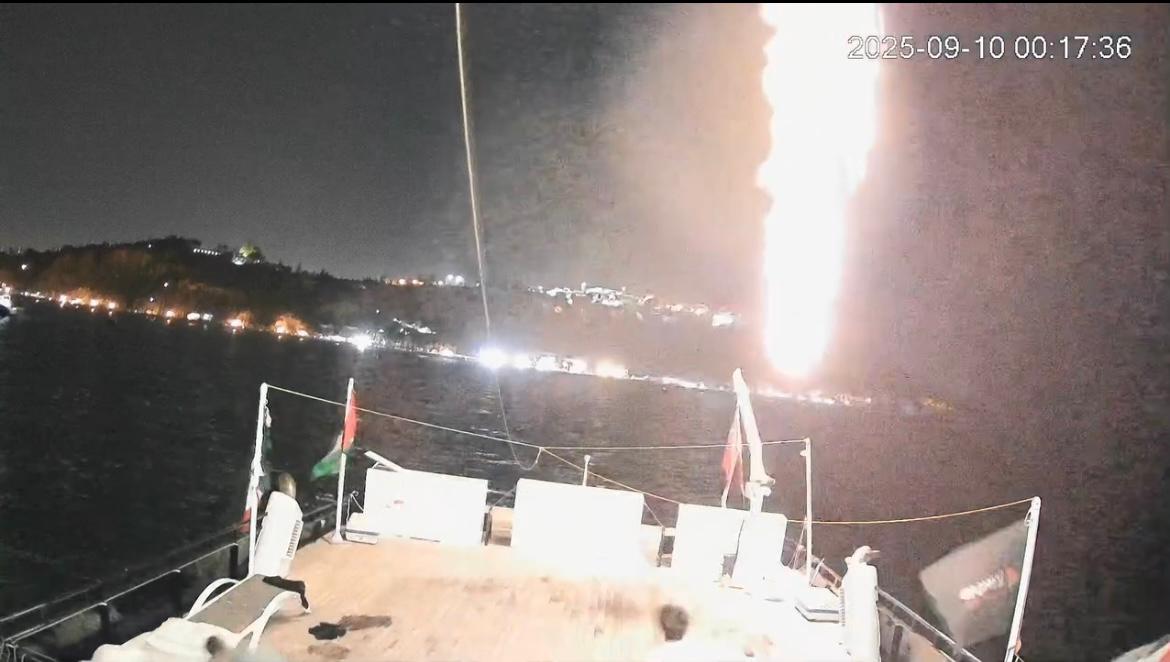
Tunis – For the second night in a row, a vessel of the Global Sumud Flotilla has been struck in Tunisian waters, just hours before its scheduled voyage to break Israel’s blockade on Gaza. The British-flagged Alma, one of the flotilla’s leading ships, was hit by what video evidence shows to be a drone, leaving its deck damaged but sparing casualties. Organizers released the footage, which directly contradicts Tunisian authorities’ claim that the incident was merely a fire caused internally.
The flotilla, carrying aid workers, parliamentarians, and activists from over forty countries, represents one of the rare collective acts of conscience in a world where governments prefer silence to justice. Israel’s decision to target it twice in two nights exposes not only its fear of international solidarity but its willingness to extend aggression into foreign territory. Such actions are clear violations of sovereignty and international law, yet Israel continues with impunity, shielded by U.S. military backing and U.K. diplomatic cover.
This is not new. In 2010, Israel’s commandos killed nine civilians aboard the Mavi Marmara in international waters. Today, the method has changed drones instead of commandos but the logic remains the same: criminalize aid, terrorize activists, and tighten the siege on Gaza’s two million trapped civilians. The blockade, condemned as collective punishment, has pushed Gaza into famine, collapsed its health system, and left children dying from hunger and preventable disease. To attack a flotilla carrying medicine and food is to declare war not on militants, but on life itself.
Strategically, the strikes are meant to break morale. Yet they reveal something else: the moral collapse of Israel’s allies. Washington supplies the bombs, London supplies the cover, and European capitals look away. Meanwhile, Arab regimes from Cairo to Riyadh to Abu Dhabi hide behind diplomacy while striking deals with Tel Aviv. Their betrayal is not just political; it is religious. In Islam, to protect the oppressed is a duty, and to abandon them for trade and Western approval is a sin. Their silence while Gaza starves is recorded in history as complicity.
Humanitarian law forbids starvation warfare, forbids targeting civilians, forbids attacks on aid workers. Israel has done all three, and more. The April 2024 killing of World Central Kitchen staff proved this pattern; the drone strikes in Tunisia confirm it. This is not about “security.” It is about enforcing an apartheid blockade, punishing a population, and silencing those who dare to resist.
Tunisian authorities, eager to avoid confrontation, continue to deny the strikes, blaming life jackets and cigarettes instead of acknowledging Israeli drones. But witnesses, video evidence, and even UN Special Rapporteur Francesca Albanese present at the port confirm what the footage shows plainly: a deliberate aerial attack. The flotilla’s organizers call it intimidation, but insist they will sail on. And across Europe, Asia, and Latin America, protests are rising, exposing the gulf between ordinary people demanding justice and governments enabling oppression.
The second attack on the Global Sumud Flotilla is more than a maritime incident. It is a test of conscience. Israel, emboldened by its Western patrons and Arab partners, strikes aid ships in foreign ports without consequence. The United States, United Kingdom, and regional regimes cover its crimes while preaching “human rights.” And Gaza continues to bleed. Against this machinery of betrayal, the flotilla sails on its persistence a reminder that where states fail, ordinary people step forward.
This is not simply about whether ships reach Gaza. It is about whether humanity still has a voice, or whether bombs, drones, and silence have won.